Course Description: Numerical computing and analysis are fundamental tools in science and engineering. The goal of
numerical analysis is to approximate solutions to complex problems using simple arithmetic operations. By structuring these operations into algorithms, we can leverage computational power to solve challenging mathematical problems efficiently. This course covers key topics, including error analysis, root-finding methods, interpolation, numerical integration and differentiation, least squares methods, and eigenvalue problems and applications.
Prerequisites: MATH 221 (Multivariable Calculus), MATH 222 (Linear Algebra), familiarity with a computer
language, preferably Python.
Programming: Part of this course involves implementing the discussed algorithms using a computer. While prior programming experience is helpful, it is not required. We will use Python, an open-source programming language, for computational work. Although Python will not be explicitly taught in this course, resources, including descriptions of relevant commands and example programs,
will be provided on Canvas.
Textbook: I will provide my own notes and Python code. However, if you are interested, the
The following books are recommended.
- Numerical Analysis with Python, by Giray Ökten, Florida State University, and Yaning Liu, University of Colorado Denver
- Numerical Analysis, 3rd Edition, by Timothy Sauer, George Mason University
- Numerical Analysis, 10th Edition, by Richard L. Burden and J. Douglas Faires, Youngstown State University
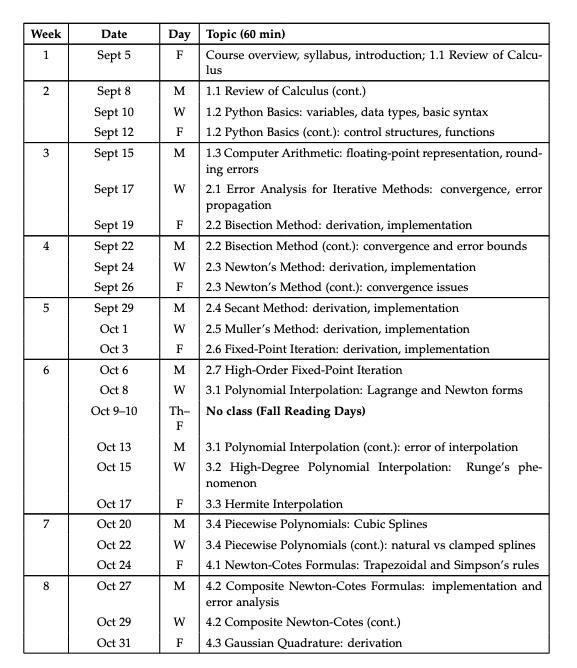
Numerical Analysis – Course Schedule (Fall 2025)
Semester: September 5 – December 5, 2025
Daily Problems (DP) and class projects, and course materials will be posted on Canvas.